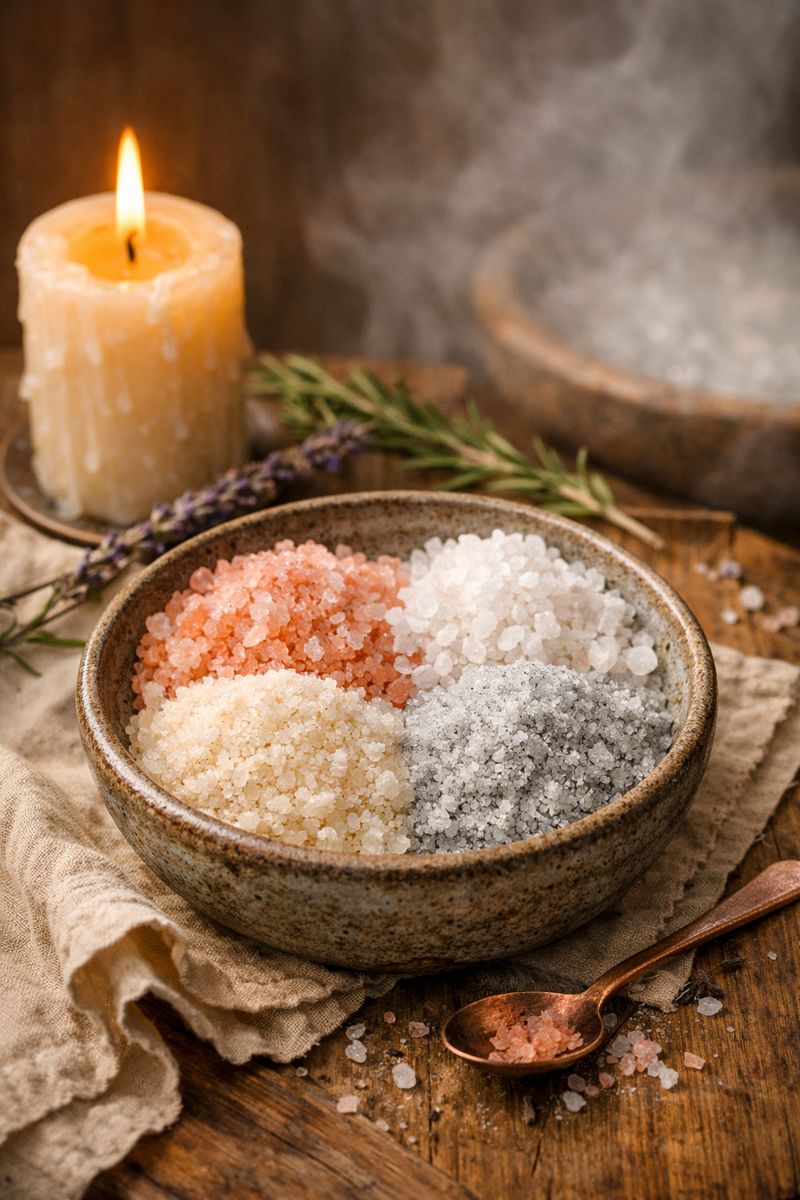
Four types of salt that will caress both body and soul after fifty
Because sometimes you don't need more discipline - but more minerals, warmth and peace.
Why you should read this
You may feel like your body is reacting differently than before. Your joints are clicking, your sleep is not as deep, and your nerves are more sensitive. Not dramatically – more quietly.
This article is not about banning salt or about scaremongering. It is about conscious choice. About how salt – chosen correctly – can support the body of a woman over fifty. And how it can become a little evening ritual, which you will look forward to.
My experience (and maybe yours)
I haven't thought about salt at all for a long time. I just salted. And the bath? A quick shower, done.
Then came a period of fatigue, tension, and worse sleep. Nothing "doctor-like." But enough for me to start listening to my body more than to advertisements.
And then I was reminded of the old truth again: the simple is often the most effective.
What's good to know about salt (without the scaremongering)
- Salt not an enemy, unless it is industrially stripped of all living things.
- Different types of salt contain various minerals, which affects muscles, nerves, hormones and skin.
- Minerals are absorbed through the skin they absorb very well – that's why baths have such a powerful effect.
And now let's move on to the four that are really worth paying attention to.
Four types of salt that make sense 🧂

1️⃣Potassium salt – a subtle energy boost
Potassium salt, often referred to as potassium chloride, is interesting primarily because replenishes potassium, a mineral essential for muscles, nerves, and fluid balance in the body.
After fifty, fatigue, weakness or muscle tension often appear - and potassium plays a role in how the body "recharges". In small amounts, it can mix with regular salt in the kitchen, making regular salting more nutritious. But look for food-grade potassium salt! They often have it in supplements for athletes!
Potassium salt in the bath
In the bath, it has a gentle but persistent effect. It helps relax muscles and promotes regeneration after a hard day.
It's not dramatic. It's more quiet. And that's why it works.
COZY tip:
Warm water, a handful of potassium salt, dimmed lights. No music. No words. Just peace.

2️⃣Sea salt – the memory of the sea in every grain
Sea salt has a stronger, fuller flavor than regular table salt. The body recognizes it immediately.
Unlike industrially purified salt, it retains natural iodine content, which is often lacking in the interior. And iodine is key for proper thyroid function – a hormonal conductor, whose balance is crucial after fifty.
In addition to iodine, sea salt also contains bromine, a mineral that supports nervous system. It helps calm tension, an overloaded head and inner turmoil. Maybe that's why you breathe so well by the sea. And sleep.
Sea salt in the kitchen
It only needs less – and the taste is deeper. It is not sharp, it is not empty. It is round and natural. Exactly the kind we appreciate after fifty.
Sea salt as skin care
In the bathroom it becomes regeneration aid. A sea salt bath promotes skin renewal and gently rejuvenates it.
Mixed with olive oil, it helps with minor burns, irritation, or inflamed areas.
AND with honey 1:1 will create a simple but effective face mask – without chemicals, without haste.
3️⃣Epsom (bitter) salt – evening rescue for nerves and sleep
Epsom salt is a compound of magnesium and sulfates. And magnesium… it’s almost a miracle after fifty.
Helps relax muscles, calm nerves, relieve tension and promote quality sleep. It is absorbed very well through the skin – that is why the bath has such a quick effect.
Magnesium supports the production of serotonin, the feel-good hormone. Sulfates help the body detoxify and relieve headaches and joint pain.
How I use it:
When I know I really want to sleep—not just lie down—Epsom salts are my first choice. The body relaxes. The mind slows down. And the night is deeper.
4️⃣Himalayan salt – mineral elegance
Himalayan salt contains dozens of trace elements, including magnesium, calcium, potassium, and iron. It has a delicate flavor and beautiful color that is soothing to the eye.
It is universal – for the kitchen and the bathroom. Coarse crystals can be used in baths, finer ones for cooking.
And yes – it is beautiful just like that. In a bowl. On a shelf. Aesthetics are not superficial. They have a direct impact on the psyche.
What can you do right now?
- Choose one salt, that appealed to you the most.
- Treat yourself one bath per week – without a phone.
- Replace regular salt in your kitchen with a higher quality option.
Small changes. Big difference.
The most common mistakes I see
- We use less salt, but poorly.
- We buy accessories instead of using them minerals in natural form.
- We view self-care as a luxury, not a necessity. foundation of health.
Summary:
After fifty, we already know that health is not about extremes.
Salt can be a burden – or a silent ally.
And sometimes the best therapy is warm water, minerals, and peace.
Personally, I have clear favorites among the solos.
I reach for the bath without hesitation Epsom salts – relaxes the body, calms the nerves, and in the evening, she has a little home spa ritual.
But sea salt and potassium salt rule the roost in my kitchen.
And potassium has another special place: I take it in the morning a pinch in warm water on an empty stomach. It gently kick-starts the body and replenishes minerals.
Just one important note:
Potassium lowers blood pressure, so if you have low blood pressure or are taking medication, use with caution and in moderation.❣💖
SPECIALTY:
Kala namak (black salt)
This almost black salt is not just an ordinary seasoning. It has a distinct mineral taste with a sulfurous undertone that reminds many of eggs – and that is why it is so prized. It contains natural minerals and trace elements, tastes „deep“, earthy and completely different from classic salt. A little of it is enough to give food character, originality and a slightly exotic touch. It is not for everyone – but those who like it will be reluctant to return to regular salt.
Hard facts:
- Actually dark purple to gray-black.
- Specific sulfur taste and smell → reminds boiled eggs.
- It is mainly used in Indian cuisine and vegan cuisine (replaces the taste of eggs).
- Contains sulfur compounds, hence the "strange" odor.
It originated in India - specifically in the Himalayas (northern India, partly also Pakistan).
It is traditionally extracted from mineral-rich volcanic rocks, which are processed in such a way that the salt retains sulfur compounds - these are what give it that typical "eggy" taste and aroma.
That is why it is considered a specialty of Indian and Ayurvedic cuisine, not ordinary table salt.
Enjoy and let us know which one is your favorite 😉

With love, Daniela
Note for our readers: Some of the links in our articles may be affiliate links (but definitely not all of them!). That means if you buy something through them, we may receive a small commission – at no extra cost to you! 💛 These little rewards help us keep the blog running: covering hosting, tools, and most importantly – the time and love we put into creating meaningful content for you. Thank you for supporting us. Every click is a sign that what we do matters.


You might also like

Možná jsme poslední generace, která vidí světlušky…

How to use a sauna for longevity, health and beauty