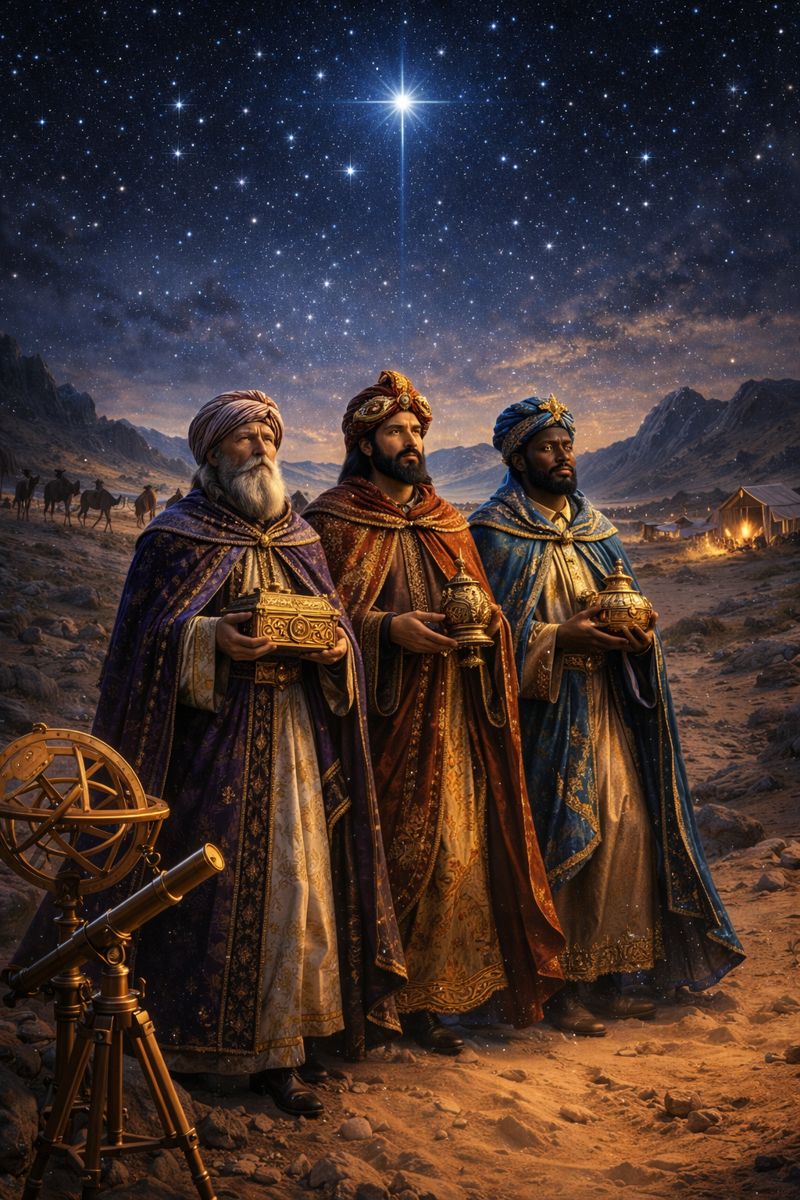
Three Kings – a beautiful custom worth knowing
Every year on January 6th, three figures wearing crowns and long cloaks walk through the streets.
When does Christmas end?
Maybe you've seen them outside your door, maybe you've heard them singing. And maybe you've wondered what the whole Three Kings pilgrimage actually means.
It's an old, beautiful custom. And it has a deeper meaning than it seems at first glance.
The Feast of the Three Kings marks the end of the Christmas season.
The day when the tree is slowly taken down, the candles are extinguished, and the house returns to its normal rhythm. It's not sad - it's just the natural conclusion of something beautiful.

For Christians, it is the moment when Christ appeared to the whole world. The day when wise men from faraway lands arrived to see him and recognized him as a king.
And Shrovetide begins – a time of revelry, feasting and fun that lasts until Ash Wednesday.
Who were the three kings really?
Do you know their names: Caspar, Melchior, Balthazar. But did you know that it wasn't actually about the king?
They were wise men. Probably astronomers from Persia or Arabia, people who understood the stars and could read the future from them. The Bible only briefly mentions them – it doesn’t give their number or their names. All of that came later, with the narrative gradually taking shape.
But the story remained the same: three men followed a shining star, knowing it would lead them to a new king.
Gold star and three gifts
They traveled for days. Carrying precious gifts with them, they expected to find gold, a palace, power.
Instead, the star led them to a stable outside Jerusalem. There, among the straw walls and the animals, lay a baby.
And they bowed down to him.
They brought him gold – symbol of royalty. Incense – the fragrant resin that was burned in temples and its smoke rose to heaven as a prayer. And myrrh – a precious substance used for embalming, a harbinger of what was to come.
Each gift had a meaning. Together they represented everything: metal, gas, liquid. Matter and spirit.

K+M+B – it's not what you think
When the three kings leave your door, they will write in chalk above the threshold: K+M+B+ and year.
Most people think it's their names. But it's not.
This abbreviation comes from Latin: Christus Mansionem Benedicat – May Christ bless this house.
The crosses between the letters are not connectors, but symbols of the Holy Trinity. The inscription remains on the door all year round – as a silent protection that is supposed to bring peace and safety.
But in some places, people immediately erased the letter K after the carolers left. They believed that otherwise the hens wouldn't lay enough eggs. Such superstitions accompanied the lives of our ancestors - they were part of their world.
Holy water, chalk and fortune telling
On Epiphany, water, chalk, incense, even apples were blessed in churches. Holy water was sprinkled on houses, barns, and fields. Protective circles or signs were drawn on doors with chalk.
Women wore consecrated chalk in a pouch around their neck after giving birth. It was placed in the crib of newborns. Protection was everywhere – visible and invisible.
And fortune telling was done. From the stars, from the flame of candles, from objects hidden under a bowl. People wanted to know what the new year would bring – health, happiness, love, harvest.
Housewives baked cookies and hid a coin in the dough. Whoever found it became the king of the household and he had the right to consecrate the entire house with holy water. It was an honor.
The Epiphany Collection – a tradition that lasts
Today, the Three Kings don't just walk around. They walk around with a money box.
The Three Kings Day fundraiser is the largest charity event in our country. Carol singers – often children, students, volunteers – go from house to house, sing carols and collect money for those in need.
It's beautiful. An old custom has taken on a new meaning.
Why does this still make sense today?
You may not be a believer. Neither do I! Maybe the Bible stories mean nothing to you, but they have meaning and are still part of history!
But still, there is something about this holiday.
It's a reminder that even in the humblest places there can be something precious. That the path to truth sometimes leads in a different direction than we expected. That gifts have meaning, even when they're not visible.
And that the blessing of a home – whether it be faith, love, or simply peace – is something worth wishing for.
So when you see the three kings at your door, stop for a moment. Listen to their singing. And you might say to yourself: yeah, that's nice.

With love, Daniela
Note for our readers: Some of the links in our articles may be affiliate links (but definitely not all of them!). That means if you buy something through them, we may receive a small commission – at no extra cost to you! 💛 These little rewards help us keep the blog running: covering hosting, tools, and most importantly – the time and love we put into creating meaningful content for you. Thank you for supporting us. Every click is a sign that what we do matters.


You might also like
Beaver Full Moon … in Taurus November 5, 2025 at 2:19 PM
New Moon in Libra – a time of balance and new beginnings