We stop speaking Czech. And we hardly notice it!
When you read Czech but think English – I recently sat over a text where the author wrote about how she was going through some personal journey and is working on his mindset, to achieve self-care and better performance in my life...
Seriously?
… is that Czech? Or not? It was. Formally. But the language in which it was written was somewhere else entirely.
And at that exact moment, something clicked for me.
It's not about words. It's about something much deeper – about who determines how we think today. And whether we even realize it.
We've experienced this before. Just with a different flag.
Remember how they said that under the Habsburgs we spoke Czech only at home, in the kitchen, among our own people? That the language of power and education was different – German, Latin, anything but this „ordinary“ language of the people? This is exactly what they taught us as an example of oppression. As something that our ancestors had to consciously defend themselves against. And they did defend themselves – the whole national revival was at its core about taking back our language, because language is thought. And thought is freedom.
Well, now look around you.
Today it's not German. Today it's English – and it comes with a smile, with the shine of success, with the friendly face of technology and the global world. No one forces us. That's the catch. We ourselves desire it. We tell ourselves that it is modern, practical, effective. And yet exactly the same thing is happening as it was back then – only without visible violence. And that is perhaps why it is stronger.

When you take over a word, you take over the thinking behind it.
Linguists call this linguistic relativity—a dry academic term for a very specific thing. The language you think in shapes how you see the world. It's not about whether you can speak English. It's about what happens when you start replacing your own world of thought with a foreign framework. When instead of self-care you say self-care, you don't just take a word. You take the whole cultural package – what self-care means, what it should look like, what's part of it. And someone packed that package for you. Elsewhere. With a different background, different values, a different history.
I don't mean to say that English is bad. That would be stupid and frankly hypocritical – I use it myself, I read it myself, I need it myself. But there's a difference between, use language as a tool, and thus, to think in his categories as the only possible ones.
What really annoys me – and why you should know too
And here comes what really annoys me. Not words like meeting or online – that's just reality, and beating ourselves up about it would be ridiculous. What annoys me is this: that Czech is starting to be perceived as a language ordinariness. Like something a little outdated, a little rustic, a little inadequate. As if saying something in Czech meant being less smart, less modern, less successful.
And this, my dear, is the problem. Not a linguistic one – an identity one.
Because we, women who remember more eras, know how this game works. We've seen it firsthand - how language changes subtly, and with it, what is "right," what is "normal," what is "modern." First the words change. Then the values change. And then one day you realize that you're thinking in categories you didn't choose.
Grandma could do it in one sentence. We need an English expression.
However, absolutely everything can be expressed in Czech.. And beautifully. Czech is an incredibly rich, layered language, full of subtleties, humor, irony, and precision that English sometimes lacks. But this richness is lost when we stop using it. Words that no one uses don't disappear slowly - they disappear quietly, without saying goodbye.
I remember how my grandmother could describe something in one sentence so that you immediately knew how it felt, how it looked, how it smelled. None mindset, none journey. Simply living, precise, real language. And I wonder – where is it today? Who will pass it on?
This is not a war with English. This is a conscious decision.
I don't want to be the one who clenches her fist and calls for a language cleanse. That would be pathetic and unnecessary. But I want to be the one who asks out loud: are you noticing? Are you aware of what's happening? Not so that you can declare war on Anglicisms now - not really. But so that it's not a silent change without your awareness. Without your decision.
Because the biggest changes never come by force. They come by comfort. They come by fashion. They come with the feeling that we want to belong – to the more modern, more successful, more global ones.
And maybe it's time to ask: belong where, actually? And at what cost?
Language is home. And you protect your home consciously.
We are not losing our language. We are losing the certainty that our language is enough. And that, I think, is the most important sentence in this whole story. Because the language in which we think, decide, love and argue – it is not just a tool of communication. It is a home. And a person should protect their home consciously. Not out of fear. Out of respect for themselves.
In conclusion:
Language is not just a set of words. It is memory, experience, and the way we understand ourselves. As Josef Jungmann reminded us:
„"Language is the image of a nation."“
And therein lies its strength and vulnerability.
It's not about resisting every foreign word. That would be naive. It's about something deeper — not losing the confidence that our own language is enough. That we can use it to name the world, values, and our own lives without needing outside support.
Because once a language weakens, what stands behind it also weakens. As František Palacký warned:
„"A nation that forgets its language loses its soul."“
And perhaps Ludwig Wittgenstein put it most accurately:
„"The limits of my language are the limits of my world."“
So the question is not how many English words we use.
The question is whether we can still fully experience our world and describe it in our own language.

With love, Daniela
Note for our readers: Some of the links in our articles may be affiliate links (but definitely not all of them!). That means if you buy something through them, we may receive a small commission – at no extra cost to you! 💛 These little rewards help us keep the blog running: covering hosting, tools, and most importantly – the time and love we put into creating meaningful content for you. Thank you for supporting us. Every click is a sign that what we do matters.


You might also like

Christmas cookies: With love with a cup of tea or coffee
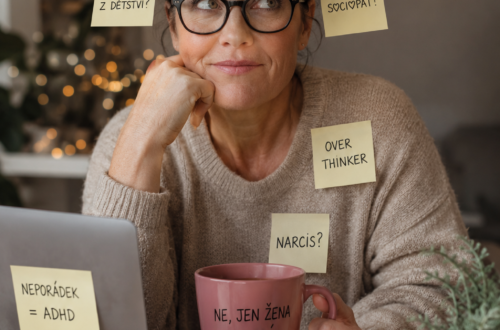
ADHD A SPOL – moderní nálepka – DIAGNÓZA