Holy Week: Why is Monday blue and Thursday green?
A wreath of willow twigs on the door, the smell of butter in the kitchen, eggs on a string on the window — and you wonder what we're actually celebrating.
There's a story behind every name of every day this week that's worth knowing. So pour yourself a drink, sit back, and let's get started.

Palm Sunday: Where it all begins
Passion Week, or Holy Week, begins Palm Sunday — and the name is not just any name. It commemorates Jesus' entry into Jerusalem, where people welcomed him with palm branches. Palm trees don't grow much in our country, so willow catkins, hazel, yew, and spring branches took over. To this day, they are blessed in churches, and whoever carried them home believed that they would protect the house and the field for the entire year — until next year, when they were burned.
It is also the last day of the forty-day fast. Such a silent farewell to renunciation, before the main thing comes.
Blue Monday: Because men didn't work — and women did
And here's where it gets interesting. Blue Monday — why blue? The answer is not clear, and I like that. One theory says that churches were decorated with blue or purple cloth on this day. But then there's the other, more honest one: in German "blau" also means "unable to work." In other words — a day when there was no work. More precisely: men didn't work. In the meantime, women were preparing everything needed for spring cleaning.
Read it twice. Times may change, but this sounds suspiciously familiar, don't you think?
Gray Tuesday: By the weather or cobwebs — depends on the interpretation
Gray or Yellow — it depends on how our ancestors looked out the window. Sun? Yellow. Cloudy? Gray. A simpler name for the world than we have today. But the second interpretation is more practical: gray are cobwebs, and they had to be carefully swept away that day. The big spring cleaning continued, and those who stayed home had something to do.

Ugly Wednesday — or don't frown, or you'll be ugly all year long
This is a day that deserves its own chapter. Ugly Wednesday commemorates Judas' betrayal — and that is an ugly deed, as they say. But folk tradition went even further: whoever frowns on this day will frown every Wednesday for the whole year. So smile, even if you don't. Tradition commands it.
It is also called Sazometná because chimneys were swept — and evil spirits were driven out of the house. And the food? It had to be "ugly" — not in taste, but in appearance.
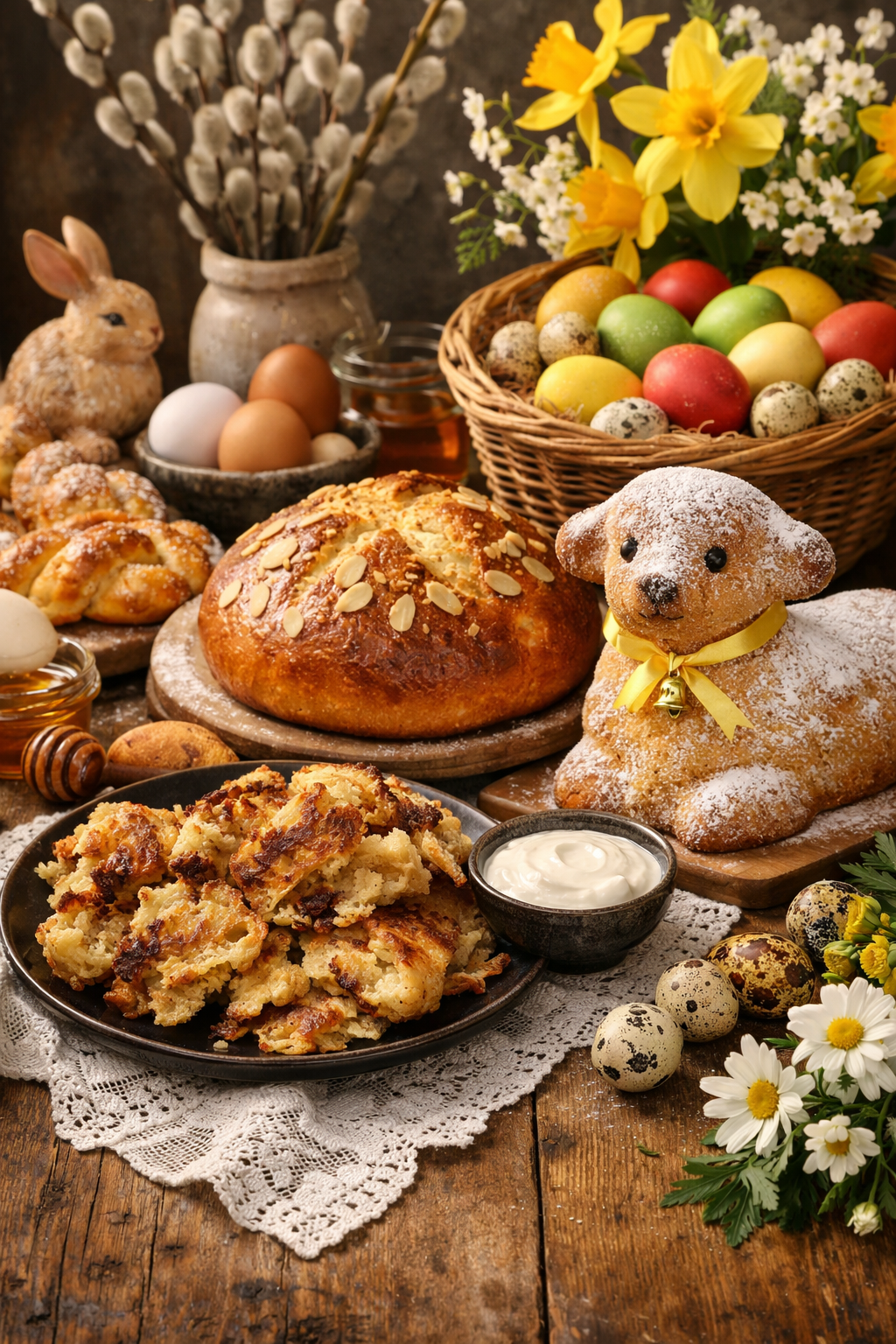
Most often, a potato pancake torn into pieces. It looked ugly, but it was good. Sometimes it's the same with the middle itself.
Maundy Thursday: The Day When Everything Comes Out
Maundy Thursday is one of those days that has a special energy — and our ancestors knew it well. It commemorates Jesus„ Last Supper, and Christians commemorate it with a service in which the priest washes the feet of twelve parishioners. Then the organs and bells fall silent — they “fly to Rome” — and are replaced by the clang of rattles.
The name Green came about a bit by accident, or rather a play on language: in German it was originally Greindonnerstag — Maundy Thursday. As an anagram, it became Gründonnerstag — Green Thursday. So there was nothing green about it originally. And yet the custom of eating green food on this day took hold: spinach, cabbage, nettles, peas. For health all year round.
And then there's that beautiful superstition: whatever you plant on Maundy Thursday will grow beautifully and will not be attacked by vermin. If you have a garden, you know what to do. The housewife swept the house before sunrise, taking the garbage behind the threshing floor or to the crossroads — to keep the fleas out. Then there was no work in the afternoon. This was a day of abundance and preparation, not toil.
Judas — a loop-shaped pastry smeared with honey — is still baked today. You eat it and wonder who came up with the idea of naming the delicious pastry after the traitor.
Good Friday: Day of Silence and Miraculous Water
Good Friday is a day of mourning — Jesus was crucified and buried. Believers gather for church services around three in the afternoon, church bells are silent, and fasting is strict.
But there is also something that fascinates me about this day: water. Easter water — the one from a spring or well — had special powers. On Good Friday, you went to the well to wash yourself; if you didn't have time, Saturday or Sunday would suffice. They say you will be more beautiful then. Good Friday water cured eye diseases, fever, and headaches. Added to dough, it protected bread from mold. It was used to wash buildings and stables, and cattle grazed in it.
On the contrary — washing clothes in the river was not allowed. It was said that it would be soaked in the blood of Christ. The old tradition prefers not to mention washing machines, so we are safe there.
And then there are the treasures. Good Friday was said to be the day when the mountains opened
— and the treasures hidden in them were briefly revealed to human eyes. Karel Jaromír Erben knew this well. And the troops? Under Blaník, under Kunětická hora, under the Vyšehrad rock — they are said to wake up on this night. Anyone moving around Velký Blaník on Good Friday should be careful. Night military maneuvers, as tradition says.
Holy Saturday: Day of Preparation and Holy Fire
White Saturday probably takes its name from the Anabaptists, who wore white robes as a symbol of purity. The morning was for mourning at Jesus' tomb, and the evening and night were for celebrating the resurrection.
Fire had a similar power on this day as water had on Friday.
Bonfires were lit in front of churches, and from their embers new fires were created in houses — with cleansing and protective powers. The ashes and embers were scattered on meadows and fields to ensure good fruit production.
And in the meantime? At home, they were preparing sweets, knitting pomlážky, painting eggs. Their hands were full of work, but it was a nice busy time.

Easter Sunday and Monday: The bells have returned from Rome
On Sunday, the bells rang — they had returned from Rome. Jesus rose from the dead, and for believers this is the greatest holiday of the year. After forty days of fasting, delicacies appeared on the tables: stuffing, butter, lamb made from yeast dough, bread, eggs, wine. A portion of the consecrated food belonged to each guest in the house — and a piece to the household, so that it would prosper.
Easter Monday is no longer technically part of Holy Week,
but who would solve that. The pomlázka, the carol, the painted egg — that's the part that even children remember. And the red color on Easter eggs? There's a reason for that: it's the color of Christ's blood.
So next time you hear "Blue Monday" on Monday or break Judas over coffee on Thursday — you'll know where the name comes from. And maybe you'll think about that spinach on Maundy Thursday: oh well, tradition has its logic. Sometimes kind, sometimes a little ugly — but always alive.
Here are four recipes — each with a story and proper steps. 🌿
Ugly Potato Pancakes (for Ugly Wednesday)🥔
Serving
4
Ingredients
- 800 g large potatoes (raw, grated)
- 2 eggs
- 3 cloves garlic (pressed)
- 3 tablespoons plain flour
- 1 teaspoon salt
- 1 teaspoon whole cumin
- 1 teaspoon dried marjoram
- 4 tablespoons oil for frying
Procedure
1
Grate the potatoes: Grate 800 g of large potatoes (raw, grated) coarsely, transfer to a towel and squeeze well — squeeze out the juice, otherwise the potato pancakes will fall apart. And we don't want that. Or actually we do, but only pretend to.
2
Mix the dough: Add 2 eggs, 3 cloves of garlic (pressed), 3 tablespoons of plain flour, 1 teaspoon of salt, 1 teaspoon of whole cumin, and 1 teaspoon of dried marjoram to the potatoes. Mix — the dough will be thick and sticky. Correct.
3
Heat the pan: Heat 4 tablespoons of oil in a frying pan.(I prefer lard!) — properly, not lukewarm. Potato chips need hot fat, otherwise they will stretch and not fry.
4
Delete — and rip!: Spoon the batter into the pan and immediately tear it into irregular pieces. No pretty patties. Tradition dictates that it should look ugly. Fry over medium heat for 4–5 minutes on each side until golden brown.
5
Serve: Serve hot, with sour cream or just plain. And smile while you do it — an ugly potato pancake and an ugly face at the same time would be too much. We used to serve it with cocoa or white coffee 😋
Comment
According to tradition, „ugly food“ was eaten — not because it was bad, but to remind us of Judas’s ugly deed. Ragged, irregular, a little chaotic. That’s exactly how it should be.
Judas with honey (for Maundy Thursday)🍯
Serving
12
Ingredients
- 500 g plain flour
- 250 ml lukewarm milk
- 25 g fresh yeast
- 2 tablespoons sugar
- 2 eggs
- 60 g butter (softened)
- ½ teaspoon salt
- 4 tablespoons honey (for spreading)
Procedure
1
Prepare the sourdough: Mix 25g fresh yeast with 2 tbsp sugar and 250ml lukewarm milk. Let it rise for 10 minutes — the yeast should start bubbling and smelling. If nothing happens, the yeast is dead and you have to start over.
2
Make the dough: Put 500 g plain flour, ½ tsp salt, 2 eggs and the risen yeast in a bowl. Add 60 g butter (softened) and knead thoroughly — at least 10 minutes by hand or 5 minutes with a mixer. The dough should be smooth, elastic and not sticky.
3
Let it rise.: Cover with a towel and let rise in a warm place until doubled in size — about 1 hour. Don't rush it. The dough knows what it's doing.
4
Shape Judas: Divide the dough into 12 pieces. Roll each piece into a rope about 12 inches long and twist it into a loop or S-shape — reminiscent of the noose Judas used to hang himself. Yes, it's a little dark. But that's how it goes.
5
Second rising and baking: Place the Judas on a baking sheet lined with baking paper, let it rest for 20 minutes. Bake in a preheated oven at 180 °C for about 15–18 minutes until golden brown.
6
Spread with honey: Immediately after removing from the oven, spread 4 tablespoons of honey (for brushing) — the honey will soak into the warm pastry and create a beautiful shiny layer. Eat warm, ideally with coffee and knowing that you deserve something good.
Comment
On Maundy Thursday, people ate green foods for health — spinach, nettles, cabbage. Judas is one of them as a sweet addition. If you want to be really traditional, cook a handful of spinach with garlic — the basis was always a green plate and a sweet dot.
Mazanec (for Holy Saturday)🍞
Serving
1
Ingredients
- 500 g semi-coarse flour
- 200 ml lukewarm milk
- 30 g fresh yeast
- 100 g powdered sugar
- 3 eggs
- 100 g butter (softened)
- ½ teaspoon salt
- 2 teaspoons vanilla sugar
- 1 lemon peel (grated)
- 80 g raisins (optional)
- 30 g sliced almonds (for decoration)
- 1 egg for brushing
Procedure
1
Leaven: Mix 30 g of fresh yeast with a tablespoon of powdered sugar and 200 ml of lukewarm milk. Let it rise in a warm place for 15 minutes — the yeast should swell and bubble.
2
Make the dough: Put 500 g semi-coarse flour, the rest of the powdered sugar, ½ teaspoon salt, 2 teaspoons vanilla sugar, lemon zest (grated) and 2 eggs in a bowl. Add the risen yeast and start mixing. After a while, add the butter (softened) in pieces. Mix for 10–15 minutes until the dough is elastic and smooth. Finally, stir in the raisins (optional).
3
First rise: Cover the bowl with a towel and let it rise in a warm place for 60–90 minutes, until the dough has doubled in size. Leave it alone — don't open the oven, don't look, don't poke it.
4
Shape and second rising: Place the dough in a greased round pan (or shape it into a loaf on a baking sheet). Cover and let it rest for another 30 minutes.
5
Decoration and baking: Preheat the oven to 170°C. Brush the pastry with beaten egg and decorate with almonds (for decoration) — traditionally in the shape of a cross. Bake for 35–40 minutes, until golden brown. Test with a skewer — it should come out dry.
6
Let cool: Let the cake cool on a wire rack. If you can resist cutting it right away, it tastes best on Sunday morning.
Comment
Traditionally, the doughnut was blessed on Easter Sunday — along with the lamb, eggs, and bread. A piece of the blessed doughnut belonged to each guest in the house. Bake it on Saturday, so that the whole apartment smells good on Sunday morning, and you have some time to relax and have coffee.
Sponge cake lamb (for Easter Sunday)🐑
Serving
8
Ingredients
- 4 eggs
- 150g sugar
- 120 g plain flour
- 30 g corn flour (Maizena)
- 1 teaspoon baking powder
- 2 teaspoons vanilla sugar
- 4 tablespoons oil or melted butter
- 3 tablespoons milk
- 3 tablespoons powdered sugar for sprinkling
- 1 tablespoon cocoa or chocolate icing (for eyes and nose)
Procedure
1
Prepare the mold and oven: Preheat the oven to 175°C. Grease the lamb tin well with butter — every corner — and sprinkle with flour. Shake off any excess. Don't rush this step.
2
Beat the eggs with the sugar: Separate the egg whites from the yolks. Beat the yolks with 150 g sugar and 2 teaspoons vanilla sugar until thick and creamy — at least 5 minutes. Beat the egg whites separately until stiff.
3
Mix the dry ingredients: Sift together 120 g plain flour, 30 g cornflour (Maizena) and 1 tsp baking powder. Carefully fold the dry mixture into the egg yolk mixture, alternating with the egg whites. Then add 4 tbsp oil or melted butter and 3 tbsp milk. Mix gently with a spoon from the bottom up — not with a mixer.
4
Furnace: Pour the batter into the pan — just to the edge, no further. Place in the center of the oven and bake for 40–45 minutes. Do not open the oven for the first 30 minutes. Check with a skewer.
5
Cool and flip: Let the lamb cool in the tin for 10 minutes, then carefully turn it out — slow and steady. Let it cool completely on a wire rack.
6
Ornament: Sprinkle 3 tablespoons of powdered sugar on top. Make eyes and a nose with 1 tablespoon of cocoa or chocolate frosting (for eyes and nose) or add chocolate candies. The finished lamb belongs on the table on Sunday morning — next to a sandwich, coffee, and a sunny morning.
Comment
Grease the lamb pan well and dust it with flour — every nook and cranny. It depends on whether the lamb comes out whole or in two pieces. Both scenarios are edible, but only one is photogenic.
...maybe you do it completely differently.
Maybe you have your own traditions, your own recipes, your own little rituals at home that you won't find anywhere in books.
And that's the best part.
So go with them 😉
I like to be inspired... and maybe we can pass them on to others.

With love, Daniela
Note for our readers: Some of the links in our articles may be affiliate links (but definitely not all of them!). That means if you buy something through them, we may receive a small commission – at no extra cost to you! 💛 These little rewards help us keep the blog running: covering hosting, tools, and most importantly – the time and love we put into creating meaningful content for you. Thank you for supporting us. Every click is a sign that what we do matters.



[…] If you have a crystal at home – green aventurine or rose quartz – place it on the paper. If not, nothing will happen. Just think about it. And say to yourself – out loud or in your mind: I am ready to grow. Everything I sow with love germinates in due time. […]