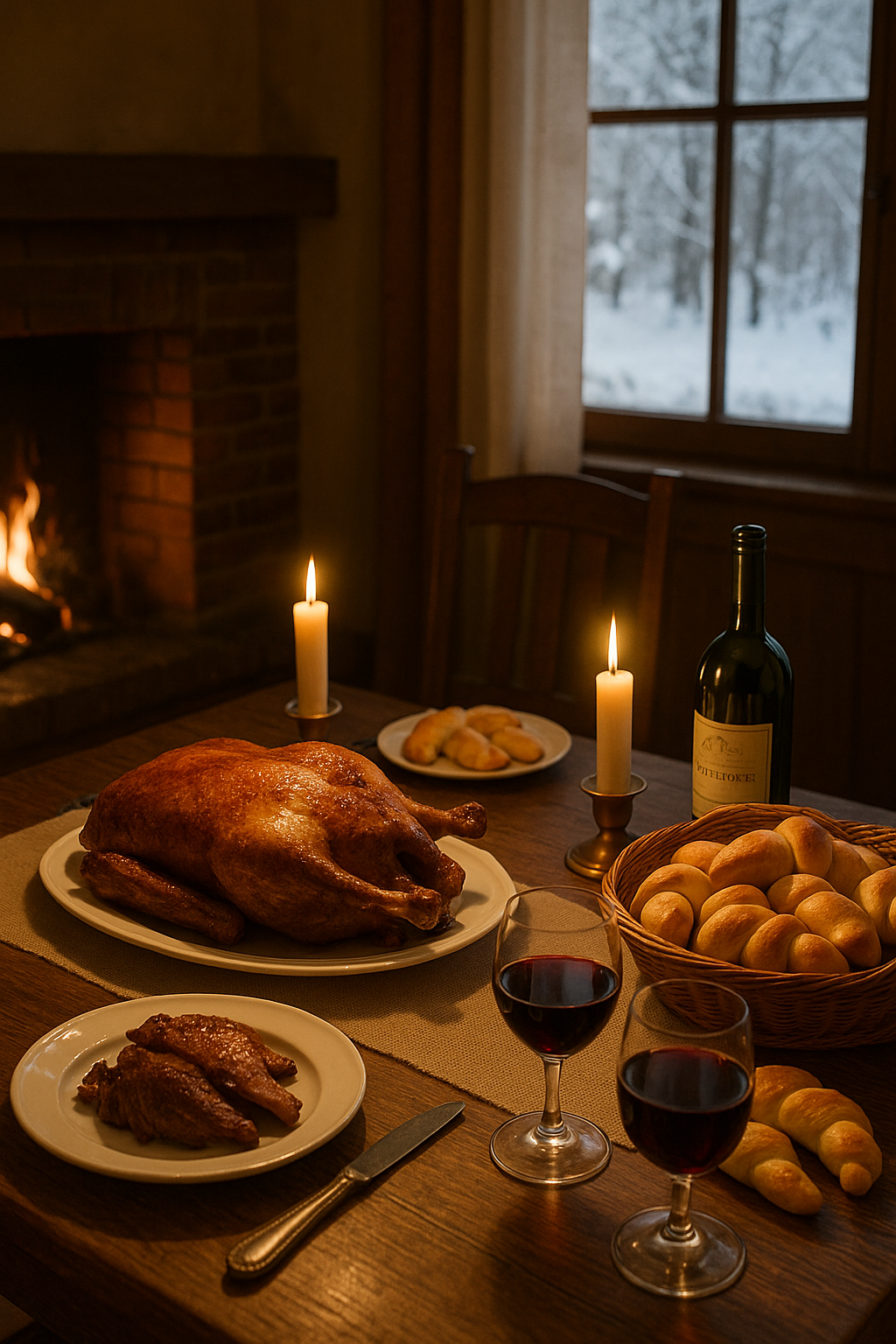
Saint Martin of Tours: More than just a roast goose
Saint Martin's Day – Tuesday, November 11, 2025
Wisdom for Women 50+
Dear ladies, age after fifty brings with it a rare gift – the gift of understanding and calm wisdom. We no longer have to chase trends, but we can sit back, pour ourselves a glass of the first St. Martin's wine and look back on old traditions with a clear view. St. Martin's Day, which in 2025 falls on Tuesday, November 11, contains much more than just fragrant roast goose and young wine.
Let's look at Martin Tourský through the eyes of a woman who already knows that what's most important is what's hidden beneath the surface.

The Legend of the Cloak: On the Power of Love for One's Neighbor
We all know that iconic image: Martin, Roman soldier, He sits on a horse and cuts his precious military cloak in half with his sword to give half to a frozen beggar at the city gate.
When you understand this, you will be relieved – really.
There is no need to change anything – just understand. This story is not about Martin not having money and so donating the fabric. It is about a much deeper, almost visceral gesture: gave a piece of himself. After all, a soldier's cloak was his calling card, his protection, his status symbol. To give it half meant to humble oneself, to hurt oneself, but at the same time to show the purest form of compassion. Isn't that instructive? We all wear the "cloaks" of our identity - the roles of wife, mother, professional. Martin shows us that in true compassion we must be willing to shed a little of these of their own Put away the coats.
The following dream, in which Martin saw Jesus dressed in this very half of the cloak, was the turning point for him. It had a profound impact on him: he was baptized, left the army, and dedicated his life to charity. Martin tells us that the love we give comes back to us in its purest form.
The Legend of the Goose: On Accepting One's Own Value
Martin was so modest that he hid in a goose barn before being elected bishop. However, the geese betrayed him with their cawing and he had to take up his office. This story gave rise to the tradition of roasting St. Martin's goose.
The body often tells us more than the mind allows us to hear.
This legend is a beautiful lesson about accepting your own potential. How many times have we, in our modesty, tried to hide our talent, our experience, just to avoid drawing attention to ourselves? The geese, paradoxical as it may seem, did not punish Martin. They freed him from his hiding place. They showed him that his value is so great that it cannot be silenced. For us, women 50+, this means: Do not hide your wisdom, your life experiences. Even if silence is pleasant, sometimes you need to let your whining be heard and accept your important role in the family, in society, with humility, but also pride.

Gastronomy: Celebrating Abundance Before Calming Down
Today, Martin in the Czech Republic is associated mainly with feasting – young St. Martin's wine and roast goose. Historically, however, this was not just a whim, but a logical divide:
- End of the Fiscal Year: Around November 11, the family's service with the landlord ended, wages were paid, and benefits were paid (often in the form of a fattened goose).
- Before Advent Lent: The goose and the fatty meal was the last great feast before Advent, a time of calm and fasting.
The feast of St. Martin gives us the opportunity to realize that life is cyclical. Let us indulge in a sense of abundance and celebration (with baked rolls filled with poppy seeds and a glass of wine) so that we can then calmly immerse ourselves in the silence and contemplation that the approaching winter and the Advent season bring. The arrival of Martin on a white horse, symbolizing the first snow and the arrival of winter, is rather a gentle but clear warning: "Enjoy yourself, the calm/winter is coming."„
A Little „Aha Moment“ at the End
St. Martin's Day is not just a date on the calendar for winemakers and chefs. It is a reminder that the greatest wisdom is connected to an act of mercy (the cloak) and self-acceptance (the goose). A celebration of calm, yet conscious, abundance before we retreat into ourselves for winter introspection. It is simply the ideal holiday for women who already know that the best feast is the one that feeds us not only in body but also in soul.
In the Czech environment, the feast of Saint Martin of Tours had and still has several key meanings:
Pranostics: The Arrival of Winter 🌨
- Martin on a white horse: The most famous pranostika. In historical times, a significant cooling and often the first snow actually came around November 11. Today, this is not so certain, but symbolically Martin ends autumn and announces winter.
- Fortune telling from a goose: In the past, the weather was predicted by the bones of a roasted goose. If the breastbone was dark, a rather muddy winter was expected. If it was light, a harsh and snowy winter was expected.
Economic Divide and Service Change 💰
- End of services: November 11th used to be the date for concluding contracts and paying wages to the family and employees (shepherds, night workers). The family's service with the landlord ended, they received their wages and could either extend their contract or look for a new one (that's why the rolls and cakes they received were called vandrovnice).
- Taxes and benefits: Previously, various fees and rents from the nobility were also paid on this date, often in the form of in-kind payments – fattened geese.
Gastronomy: Goose and St. Martin's wine 🍗
Today, the most visible and popular tradition, the goose and new wine signaled the end of the season of abundance before the start of the Advent Lent.
- St. Martin's Goose:
- Legend: According to one legend, the geese disturbed Martin's sermons by cawing, for which they were punished in a roasting pan. According to another, Martin hid in a goose barn before being elected bishop (out of humility), but the geese gave him away with their cawing.
- Practical reason: It was the last fat and meaty feast before the Advent fast (which began on November 12, but is only observed symbolically today).
- St. Martin's Wine: A tradition that was revived in the Czech Republic after 2005. These are the first wines of the new vintage to reach the table from the vineyard. Symbolically, they open on November 11th at 11:11 and are fresh, light and fruity.
- Martin's Pastry: Typically rolls, horns or horseshoes (sometimes called Martins or Martinské rohlíčky) made from yeast dough, filled with poppy seeds or jam.
🌍 Saint Martin's Day Celebrations Around the World
Saint Martin of Tours is an important saint for all of Europe (he worked in France, was born in Hungary), and therefore has celebrations in many countries.
| Country | Customs and Traditions | Gastronomy |
| Germany | Lantern processions (Laternenumzug) children who sing St. Martin's songs. The processions often end at St. Martin's Day fire. | Martinsgans (roast goose, often stuffed with apples and plums) and Martin's cookies (pastry in the shape of a goose or a figurine – Weckmann). |
| Austria | Similar to Germany, lantern parades. In Burgenland it's November 11th even public holiday, because Martin is the patron saint of this federal state. | Martinsgans and tasting young wine. |
| Poland | St. Martin's Day. Great celebrations and charity (donation of food and money to those in need, following the legend of the cloak). | Traditional St. Martin's roll (Rogal Świętomarciński) stuffed white poppy. Roast goose is also common. |
| Italy | The celebrations are associated with young wine and roasted chestnuts. In Venice, children walk around with tin cans and make noise while singing carols. | Traditional donuts (San Martino fritters) and desserts soaked in sweet wine. |
| Switzerland | Celebrations can be associated with the beginning of the carnival season. A controversial custom takes place in the town of Sursee beheading a dead goose with a scarf over his eyes. |
In recent years, the St. Martin's tradition in the Czech Republic has been predominantly gastronomic, but it has interesting nuances that make it a little different from the "dust-free consumption" of Christmas:
- No pressure for gifts: Martin is not associated with pressure to buy gifts or accumulate possessions. It is a social and culinary experience.
- Short period of time: The marketing campaign for St. Martin's Wine and Geese only lasts for a few weeks, culminating on November 11th, and then fades away. It doesn't try to infiltrate the entire fall like Christmas ads.
- Absence of massive foreign symbolism: Even though Martin is originally a Roman soldier from Pannonia, his celebrations are relatively localized (lanterns and geese) and the massive global symbols like Santa, elves, and reindeer that make up the "American" commercial wave of Christmas have not spread to us.
So St. Martin's Day is gastronomic marketing, but with a positive impact on maintaining tradition and supporting local producers. It is more of a celebration of abundance and gatherings before the period of calm.
The perfect choice! Roast goose and rolls are the perfect combination to celebrate St. Martin's Day at home.
🥐 St. Martin's Rolls (Martiny)
St. Martin's rolls are typical yeast pastries, most often filled with poppy seeds or jam.
Preparation time: 30 minutes | Leavening: 60–90 minutes | Roast: 15–20 minutes
Ingredients:
For the dough:
- 500 g plain flour
- 80 g caster sugar
- A pinch of salt
- 250 ml lukewarm milk
- 100 g butter (melted, but not hot)
- 2 egg yolks
- 42 g yeast (1 cube)
For the Poppy Seed Filling:
- 150 g ground poppy seeds
- 150 ml milk
- 50 g sugar (to taste)
- 1 packet of vanilla sugar
- Lemon zest (grated, optional)
To finish:
- 1 egg for brushing
- Powdered sugar for sprinkling
Procedure:
- Preparing the sourdough: Crumble the yeast into lukewarm milk (be careful, it must not be hot!), add a teaspoon of sugar and let the yeast rise in a warm place (about 10–15 minutes).
- Kneading the dough: Put the flour, the rest of the sugar and the salt in a bowl. Add the yeast, melted butter and egg yolks. Work smooth and elastic dough. Cover the bowl with a towel and leave to rise in a warm place until the dough doubles its volume (60–90 minutes).
- Preparing the filling: Bring the milk and sugar to the boil, add the ground poppy seeds and cook, stirring constantly, until the filling thickens. Set aside and let cool.
- Shaping the rolls: Divide the risen dough into two parts. Each part roll out into a thin circle (approx. 3 mm thick). Cut the circle into 8 or 16 triangles (like a pizza).
- Filling: Place a teaspoon of poppy seed filling on the wider edge of each triangle. Roll up from the wider end to the tip and bend into a roll shape (horseshoe).
- Roast: Transfer the rolls to a baking sheet lined with baking paper. Brush with beaten egg and bake in preheated oven to 180 °C about 15-20 minutes until golden brown.
- Completion: Let the finished rolls cool and before serving sprinkle with powdered sugar.
Enjoy your meal and may your St. Martin's feast be a success!
- „"There's usually a good goose on St. Martin's Day."“
- „"On St. Martin's Day, stay by the chimney."“
- „"Saint Martin is coming on a white horse."“
- „"When Martin arrives on a white horse, blizzard after blizzard is chased."“
- „"If the sky is clear on Martin's Day, a dry Christmas is certain."“
- „"Saint Martin - the farmer's lord."“ (because he concluded contracts, wages)
- „"On St. Martin's Day, smoke comes out of the chimney."“

With love, Daniela
Note for our readers: Some of the links in our articles may be affiliate links (but definitely not all of them!). That means if you buy something through them, we may receive a small commission – at no extra cost to you! 💛 These little rewards help us keep the blog running: covering hosting, tools, and most importantly – the time and love we put into creating meaningful content for you. Thank you for supporting us. Every click is a sign that what we do matters.


You might also like

October full of stars: Famous birthdays of film and music legends

An icon like Audrey Hepburn? 5 things that will help you do it!