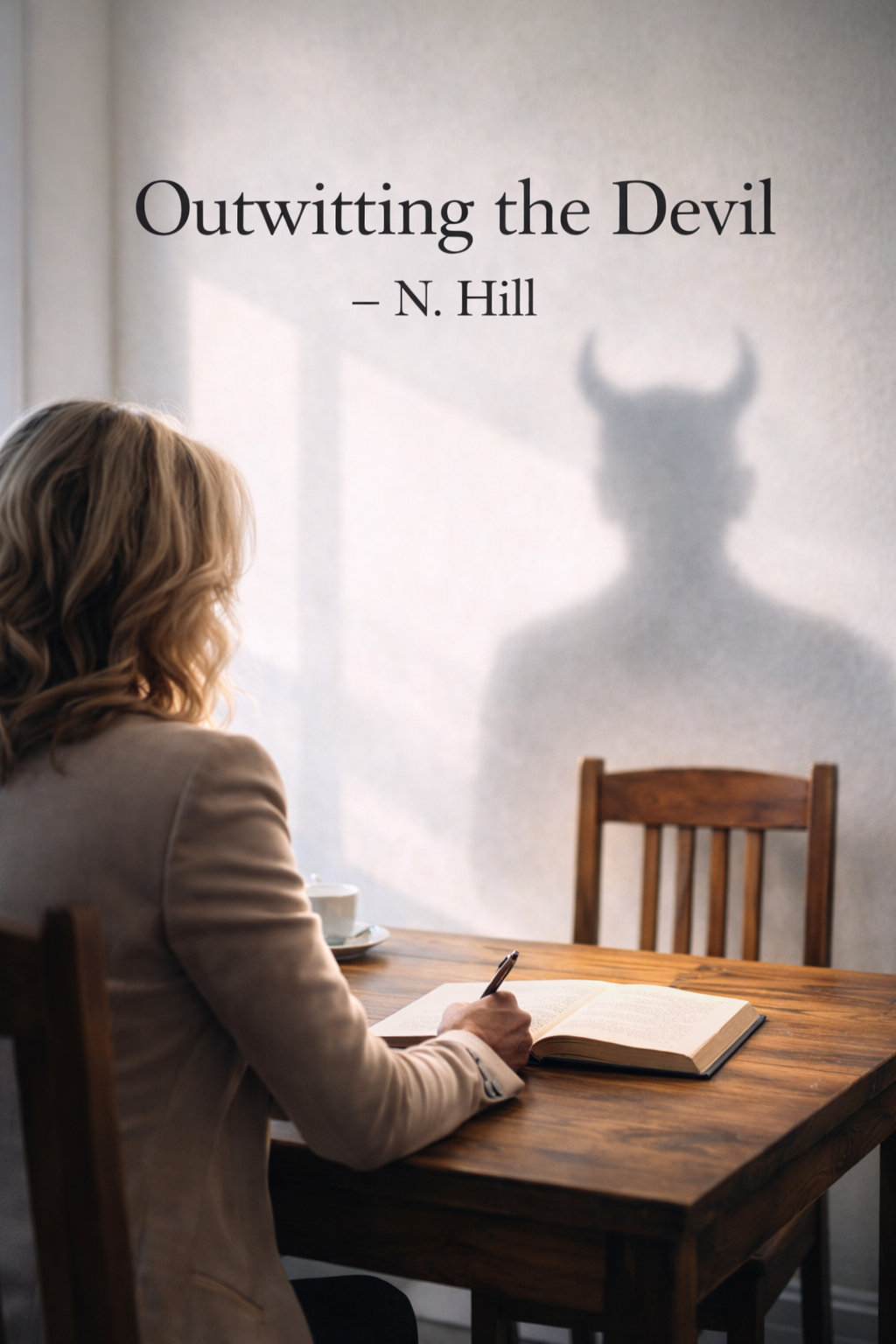
I talked to the devil. And you know what he told me?
Sure, it sounds dramatic. But that's exactly how one of the boldest books I've come across in the last few years begins!
How to Outsmart the Devil by Napoleon Hill.
And honestly? I was expecting motivational gibberish in hardcover. I got a slap in the face. A pleasant one.
Napoleon Hill wrote it in 1938. But – and this is where the interesting part starts – his wife forbade him from publishing it. Were too many people afraid of what was written in it? It was published after his death. Do you think about it too? What must have been in the book that someone had hidden it away as something dangerous all this time?
How to Outsmart the Devil (original) Outwitting the Devil) and Napoleon Hill wrote it in 1938, just a year after his most famous work, Think and Grow Rich.
Here are the details of this interesting story:
Reason for non-issue: Hill's wife (Rosa Lee Beeland) and some of his close friends feared that the book's content was too controversial, provocative, and could damage his reputation. The book openly criticized organized religion, education, and other social institutions that, according to Hill, help people become "aimless drifters" without realizing it.
Book contents: The work is conceived as a conversation between Hill (who calls himself "Mr. Earthling") and the Devil himself. In the book, the Devil admits that he controls the minds of 98 % people through fear, procrastination, and negative thinking.
Long wait: The manuscript remained locked in a drawer (in the Napoleon Hill Foundation archives) for almost 70 years.
Edition: The book was first published only in 2011 (with annotations by Sharon Lechter), long after Hill's death in 1970.
Today, this book is considered one of Napoleon Hill's key "lost" titles, which adds to his philosophy of success the psychological level of overcoming inner fears.
The book is today considered one of his most profound works.
Well, then you read it – and you understand.
In it, Hill has a conversation with the devil. Literally. He sits him down across from him and asks: How do you do it? How do you get people under control? And the devil – with icy calm – answers. And the answer, girls, is so uncomfortably accurate that you don't want to read it because it makes you look in the mirror a little differently than you do in the morning when you put on your makeup.
The mechanism is simple and therefore ingeniously insidious. Fear and indecision. These are its two main weapons. No big drama, no life catastrophes – just quiet, everyday „not yet“, „we’ll see“, „maybe another time“, „what would they say“. Procrastination, as the English call it. We call it putting it off until tomorrow. And the devil calls it victory.
I sat with the book by the window and thought to myself: that's me. Not always. But often enough that it stung me.
Because what do we, women over 50, do most often? We wait for the right moment!
When the kids are older – well, they are already grown up. When there is more money – when exactly? When the situation calms down – what situation has ever really calmed down? And in the meantime, that idea, dream, desire or decision quietly settles at the bottom of the drawer, where a layer of „someday“ lies on top of it.
Hill says – and this is where I liked him the most – that the biggest problem isn't lack of ability. It's drifting. To be carried away by the current without any direction of your own, to let life just continue to... happen. Reacting instead of deciding. Adapting instead of choosing. And yet telling ourselves that we are living normally. Well, yes, that sounds familiar, doesn't it?
What can you take from this as a woman in the best decade of her life – because that's what being in your fifties is, no matter what the media thinks?
Above all, one thing: fear will not stop visiting you. You would be expecting that in vain. But you can stop opening the door wide open to it and offering it coffee. Hill says that independent thinking – that is, deciding for yourself what you think, what you want, how you live – is the greatest resistance you can offer to the devil (or, if you prefer: your own limits). And after fifty, we finally know how to do it. Or at least we are slowly starting to stop being afraid to try.
I finished reading the book and then I sat down and wrote down three things that I've been putting off...
It's that simple. No magic, no guru. Just paper and pencil and a little uncomfortable honesty with yourself.
I tried. And, you know, there's always room for improvement! There's always room for improvement! And there's plenty of it 😉
Be prepared for the fact that the book is from 1938 and is very „American“…yes, we know American films – so that’s about it! But I was very surprised / not surprised church evaluation and education seems to have changed nothing anywhere since 1938!
Quotes Napoleon Hilland:
- „"Living without goals is like going on a trip and not knowing where."“
- „"If we examine all great truths, we will eventually find that they are simple and easy to understand. If not, they are not great truths."“
- „"Effort only manifests itself when one refuses to give up."“
- "Isn't it strange that we fear the most what will never happen?"
- "If you do not defeat yourself, you will be defeated by yourself.“

With love, Daniela
Note for our readers: Some of the links in our articles may be affiliate links (but definitely not all of them!). That means if you buy something through them, we may receive a small commission – at no extra cost to you! 💛 These little rewards help us keep the blog running: covering hosting, tools, and most importantly – the time and love we put into creating meaningful content for you. Thank you for supporting us. Every click is a sign that what we do matters.


You might also like

The Art of Keeping Things to Yourself: The Goddess Manifesto
Saint Lucia – the night when we return to longer days ;)