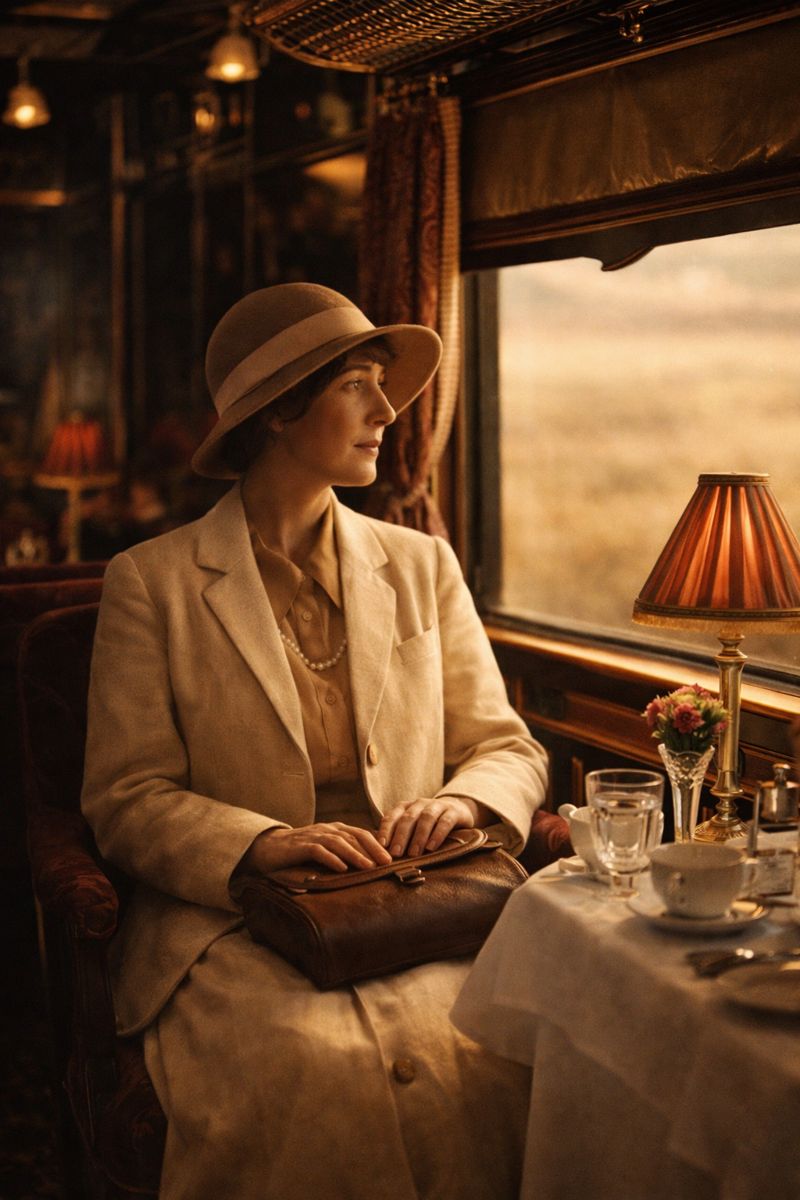
Agatha Christie: When your heart breaks at 38...
Imagine this. You're 38, recently divorced, and society expects you to hide at home with a broken heart and suffer in silence. What do you do?
You buy a ticket on the Orient Express and disappear into the Middle East.
This is not fantasy. This is the true story of Agatha Christie - a woman who proved that the end of one chapter can be the beginning of the best one.

When everything fell apart...
The year is 1928. Agatha Christie, already a famous writer, stands amidst the ruins. Her marriage to Archibald Christie ended in divorce, which not only broke her but also publicly humiliated her. A few years earlier, in 1926, she had completely collapsed after the death of her mother and a marital crisis. She disappeared for eleven days - an incident that has never been fully explained and is still the subject of speculation to this day.
She could have wrapped herself in a blanket, locked herself in her house, and felt sorry for herself. She could have done exactly what was expected of a woman her age.
Instead, she packed her suitcase and set off on a journey that changed her entire life.
The Orient Express and the courage to start over
Agatha boarded the Orient Express – the famous train that would later become the setting for one of her most famous detective stories. She traveled through the crowded bazaars of Istanbul, the deserts of the Middle East, and finally reached the archaeological site of Ur in Iraq.
She was looking for peace. She found much more.
She fell in love. Not with the person right away – first with the places. With the dust, the tents, the sun-bleached artifacts, with that special magic that archaeological sites have. She returned there. Again and again.
And then, in 1930, she met Max Mallowan.
A love that doesn't make sense (and yet it does)
Max was a young archaeologist. Talented and passionate about his work. And fourteen years younger than Agatha. Fourteen years. In 1930. Imagine the talk!
But you know what? They didn't give a damn. What developed between them wasn't hormonal madness. It was a shared curiosity, gentle conversations, respect, intellect. And then an unexpected tenderness that just happened. They married in September 1930.
A life that is not from a postcard (and is all the more beautiful)
Their marriage wasn't about roses and champagne. It was about tea on the veranda. Laughter over misdescribed artifacts. Long afternoons spent cleaning ancient relics—and yes, Agatha reportedly sometimes used her own face cream to clean the finds. Archaeologists still enjoy it to this day.
And she wrote. She always wrote. In the evening, when work stopped and the sun set over the desert.
Those Middle Eastern landscapes, the smells of the markets, the dust of excavations, the mood of foreign cities – all of this permeated her books. They created detective stories that we still read today:
Murder on the Orient Express (1934) – the train she rode on.
Death on the Nile (1937) – the river she saw with her own eyes.
Murder in Mesopotamia (1936) – a brilliant study of manipulation in the family, written between excavations.
They came to Baghdad (1951) – a city she knew like few others.
She lived in room 411 in an Istanbul hotel Pera Palace and that's where she wrote Murder on the Orient Express. The place still exists today and it's amazing.

She also wrote a beautiful book. Tell me how you live. (under the name Agatha Christie Mallowan), where she describes excavations and life in modern-day Iraq. It's not a detective story, it's a memoir. And it's worth reading.
45 years together
Their marriage lasted 45 years, until her death in 1976.
During that time, Agatha became the best-selling author of all time – surpassed only by the Bible and Shakespeare (and according to some sources, even Shakespeare). She wrote 78 detective novels, about 150 short stories, 6 „regular“ novels and 19 plays. Her books have been translated into more than a hundred languages, selling over two billion copies.
Max continued his archaeology career, becoming a renowned expert in his field and being knighted for his services.
And you know what the best part is? Agatha herself once said:
„"Having an archaeologist as a husband has its advantages. The older you get, the more interested he is in you."“
What to take from this
Agatha Christie didn't let heartbreak define her. At 38, divorced and publicly disgraced, she could have withdrawn and been a victim.
Instead, she rewrote her story.
She bought a ticket. She set out on her own. She opened herself up to new things, new places, new people. And then she met the man she spent 45 happy years with—even though everyone said it didn't make sense.
Because sometimes you just have to do what you have to do. to you It makes sense. Not to society. Not to neighbors. Not to people who "mean well.".
So the next time someone tells you you're too old, too tired, too whatever – remember Agatha. The woman who got on a train and found a whole new life.
Maybe it's time to buy a ticket. Where are you going?
Quotes- A. Christie
„"The fact that the alarm clock didn't ring has changed many people's lives."“
„"Love turns to hate much more easily than you think." — Zero Hour
"Loving someone passionately usually brings more pain than joy. But everyone should experience it anyway."“
„"You can't just trust everything people tell you. When something doesn't seem right to me, I don't trust anyone at all. You know, I know human nature very well." — Dead in the Library
In matters of love, women seldom, if ever, pay attention to their pride. They often talk about it, but it is not evident in their actions. (Zero Hour)“ — Zero Hour
PS: „"Time is just a way of thinking."“ – Agatha Christie, Tell Me How You Live
PPS: You can really read her detective stories over and over again. I have a collection of older paperback editions and I find something new in them every time. Try Murder in Mesopotamia. – the manipulation in the family is masterfully written.

With love, Daniela
Note for our readers: Some of the links in our articles may be affiliate links (but definitely not all of them!). That means if you buy something through them, we may receive a small commission – at no extra cost to you! 💛 These little rewards help us keep the blog running: covering hosting, tools, and most importantly – the time and love we put into creating meaningful content for you. Thank you for supporting us. Every click is a sign that what we do matters.





[…] with May Day. It doesn't have to replace or rewrite anything. It can just be a reminder that love has its place in European tradition – and that relationship, closeness and devotion are not fashionable […]